

A content approval workflow is the sequence a piece of content moves through, from brief to published, with a clear owner and check at each stage. Without one, drafts bounce around in email, feedback arrives in fragments, and off-brand copy slips through on a deadline. This guide lays out a simple six-stage content approval workflow built for agencies juggling many clients and writers at once.
What a content approval workflow is and why it matters
A content approval workflow is the defined path every piece of content follows before it goes live, with named owners, clear entry and exit criteria, and a review at each step. It replaces the ad hoc content review process most teams fall into, where approvals happen in scattered messages, and no one is sure what was checked or by whom.
For an agency, a clear content review workflow is the difference between scale and chaos. As client and writer counts grow, an undefined process is where deadlines slip and where the early signs of content drifting off-brand first appear. A defined workflow makes quality repeatable, protects the brand voice, and gives clients confidence that nothing ships by accident.
The content approval workflow in 6 stages
The six stages below take a piece of content from brief to published. Assign a single owner to each stage so nothing stalls in a gray area.
The core path of an agency content approval workflow.
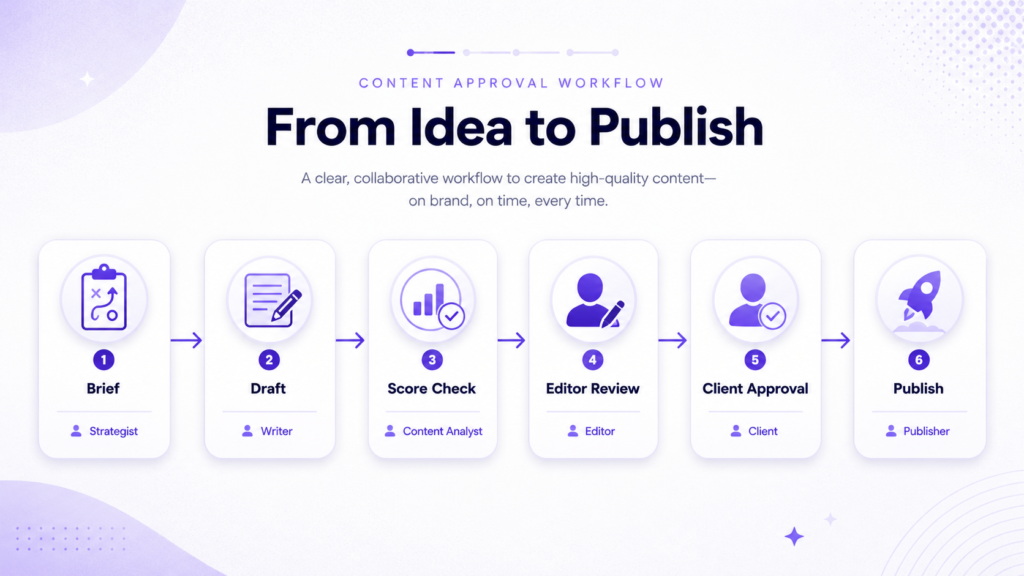
The six stages of an agency content approval workflow.
Stage 1: Brief and assign
Every piece starts with a short, complete brief, goal, audience, key points, client, and deadline, assigned to a specific writer. Why it matters: most rework traces back to a vague brief, not weak writing. Example: an invented agency, Northpath, uses a one-screen brief template so no draft starts without the essentials, which cuts revision rounds in half.
Stage 2: Draft against the brand voice
The writer drafts with the client’s brand voice in front of them, not from memory. Why it matters: it is far cheaper to write on-brand than to fix off-brand copy later. Example: Northpath keeps each client’s voice rules beside the editor so writers apply them as they go, not as an afterthought.
Stage 3: Self-check and score before submitting
Before a draft leaves the writer, it gets a quick self-check against the brand voice and the brief. Why it matters: a score gate at this stage catches the obvious slips so editors spend their time on judgment, not cleanup. Example: Northpath requires a minimum brand-voice score before a draft can move to review, so nothing clearly off-brand reaches an editor.
Stage 4: Editor review
An editor reviews for substance, structure, and voice, leaving clear, consolidated feedback in one place. Why it matters: scattered feedback across channels is where versions and intentions get lost. Example: Northpath keeps all edits on a single version, so the writer sees one coherent set of changes, not five conflicting threads.
Stage 5: Client approval
The client reviews a clean, near-final draft with a clear way to approve or request changes. Why it matters: sending polished work, not rough drafts, keeps client feedback focused and shortens the loop. Example: Northpath sends clients a tidy preview with a single approve-or-comment step, which removes the endless back-and-forth.
Stage 6: Publish and log
On approval, the piece is published and logged, who wrote it, its final score, and where it lives. Why it matters: a record turns one-off approvals into a system you can measure and improve. Example: Northpath logs every published piece with its brand-voice score, so it can spot which clients or writers trend off-brand over time.
Common mistakes to avoid
A few recurring mistakes quietly break otherwise good approval processes:
- No single owner per stage. When everyone is responsible, work stalls in the gaps between people.
- Feedback scattered across channels. Comments in email, chat, and docs create version confusion and lost intent.
- Reviewing voice by memory. If on-brand is a subjective call, it changes with whoever reviewed the draft and how busy they were.
- Sending rough drafts to clients. Unpolished work invites scattered, structural feedback and lengthens every cycle.
- No record of what shipped. Without a log of who wrote what and how on-brand it was, you cannot spot patterns or improve.
How Claritar fits into your approval process
The self-check and review stages are where a content approval workflow either protects the brand voice or lets it slip. Claritar adds an objective score gate at exactly those points: it saves each client’s voice once, scores any draft from 0 to 100 against it, flags the off-brand lines, and returns an on-brand rewrite. Writers can self-check before submitting, and editors can confirm at a glance, so on-brand becomes a threshold instead of an opinion. You can see how the scoring works and build the check straight into your review step. Pair it with clear brand voice guidelines and the workflow enforces itself.
Frequently asked questions
What is a content approval workflow?
A content approval workflow is the defined path a piece of content follows from brief to published, with a named owner and a clear check at each stage. It replaces ad hoc approvals with a repeatable process, so quality and brand voice stay consistent as volume grows.
What are the stages of a content approval process?
A typical content approval process has six stages: brief and assign, draft against the brand voice, self-check and score, editor review, client approval, and publish and log. Each stage has a single owner and clear criteria for moving to the next.
How do agencies keep content on-brand during approval?
By checking voice objectively rather than from memory. Writers draft with the client’s voice in front of them, self-check with a brand-voice score before submitting, and editors confirm at review, so off-brand copy is caught early instead of after it publishes.
How can I speed up content approvals without losing quality?
Give each stage one owner, use a complete brief to cut rework, add a score gate so editors review judgment rather than cleanup, and send clients clean near-final drafts. Consolidating feedback in one place removes most of the delay in a content review workflow.
Takeaway
A content approval workflow turns quality from a hope into a system: brief, draft, self-check, review, approve, publish, each with an owner and a clear check. For agencies, the score gate at self-check and review is what keeps the brand voice intact as volume grows, so nothing off-brand ships on a deadline.
Want an objective check inside your approval process? Add brand-voice scoring to your workflow and give every draft a score before it moves forward.