A brand voice template turns a vague sense of how a brand should sound into a few concrete, fill-in fields. Instead of a blank page, you get prompts, personality traits, preferred and banned words, tone by context, and examples, that you complete in under an hour. Below is a free brand voice template you can copy, fill in, and put to work today, with an example to guide you.
Why use a brand voice template
A blank page is where brand voice projects stall. A template removes that friction by asking the right questions in the right order, so you define a usable voice without needing to be a brand strategist. It also makes voices comparable across clients, which matters if you run an agency. If you want the background first, our guide to what brand voice is explains the concept the template puts into practice.
A template is not the same as a full guide. It is the fast, structured first draft, the version you can complete in a single sitting, then expand into detailed guidelines later if the brand needs them. For many small brands, the filled-in template is all they ever need.
The free brand voice template
Copy the template below. Each field is a prompt; keep your answers short and specific, and lean on the examples rather than adjectives.
BRAND VOICE TEMPLATE

Brand in one line: [what you do + for whom]
Personality traits: [trait 1], [trait 2], [trait 3] (+ one line each)
We sound like: [a short description of the voice]
We do NOT sound like: [what to avoid]
Preferred words: [words we use]
Banned words: [words we never use]
How we refer to customers: [e.g. members, clients, readers]
Tone by context: launch [ ], support [ ], apology [ ]
Sample sentence (on-brand): [one line in our voice]
Off-brand vs on-brand: [bad example] -> [good rewrite]
A fill-in-the-blanks brand voice template.
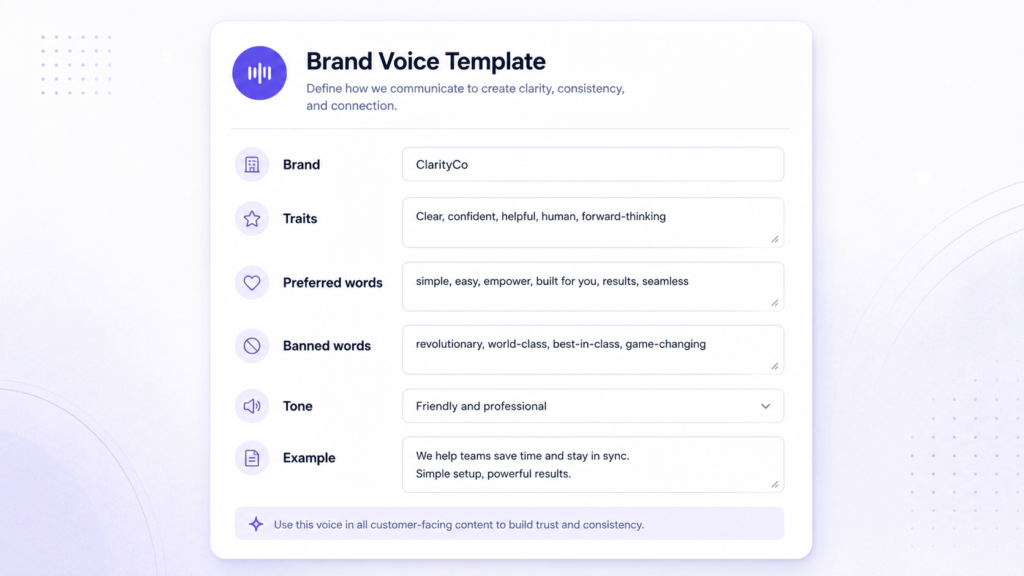
The fields of a fill-in brand voice template.
How to fill in the template (with an example)
See how each field turns from a prompt into a decision using an invented brand, Tidepool, a calm, no-nonsense budgeting app.
Personality traits
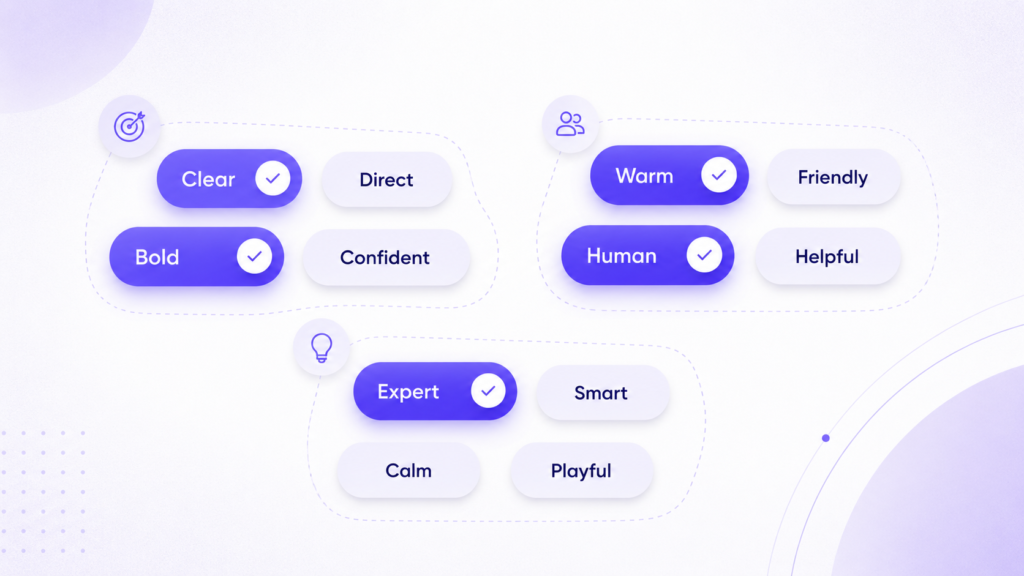
Tidepool picks calm, honest, and practical, then writes one line under each: calm means never alarmist about money, honest means naming trade-offs, practical means always giving the next step. Sharp traits with a sentence each beat a long list of vague words.
Sounds like / does not sound like
Tidepool sounds like a level-headed friend who is good with money. It does not sound like a hype-driven finance influencer. Naming the opposite is often what makes a voice click.
Preferred and banned words
Tidepool says “money” and “plan,” never “wealth” or “hustle,” and bans exclamation-heavy urgency. Word rules are the fastest way to make a voice concrete and consistent.
Tone by context
At launch, Tidepool is quietly confident; in support, it is reassuring; in an apology, it is plain and accountable. Mapping tone to a few situations keeps the fixed voice flexible without losing it.
Off-brand vs on-brand example
Tidepool pairs “Crush your money goals now!” with the on-brand rewrite “Here’s a simple plan for this month.” That single comparison teaches the voice faster than any description.
Once the template is full, you have a working voice. When you are ready to expand it into a complete document, our guide to writing brand voice guidelines your team will use shows how to grow the template into full guidelines, and a content style guide covers the mechanics that sit alongside it.
How to keep your voice consistent
A filled-in template defines the voice, but content still drifts when writers work from memory, and that is where the signs of off-brand content begin. Claritar holds the voice steady by saving your completed template once, then scoring any draft from 0 to 100 against it, flagging off-brand lines and returning an on-brand rewrite. You can see how the scoring works and turn a static template into an active check on every piece of content.
Frequently asked questions
What is a brand voice template?
A brand voice template is a fill-in-the-blanks document that helps you define a brand’s voice quickly. It prompts you for personality traits, preferred and banned words, tone by context, and examples, turning a blank page into a structured, usable voice in under an hour.
What should a brand voice template include?
A good brand voice template includes a one-line brand summary, three or four personality traits, what the brand sounds like and does not sound like, preferred and banned words, tone by context, and at least one off-brand versus on-brand example to make the voice concrete.
Is a brand voice template the same as brand voice guidelines?
Not quite. A template is the fast, structured first draft you can complete in one sitting. Full brand voice guidelines expand that into detailed rules and examples. For small brands, the filled-in template is often enough on its own.
How do I fill in a brand voice template?
Work top to bottom, keep answers short and specific, and rely on examples over adjectives. Define what the brand sounds like and does not sound like, set clear word rules, and add one before-and-after example, which teaches the voice faster than any description.
Takeaway
A brand voice template is the fastest way to turn a vague sense of voice into something usable. Copy the fields above, fill them in with short, specific answers and a real example, and you have a working voice in an hour. Then keep it consistent by checking drafts against it, so the template shapes your content instead of sitting in a drawer. Filled in your template? Save it and score your next draft against it to keep every piece on-brand.