

Brand voice consistency is the first thing an agency loses when a client account gets busy, and the hardest slip to notice while it happens. No single post looks wrong. But over a quarter, the emails, blog posts, and captions slowly stop sounding like the client, until one day the client notices before you do. Below are seven signs a client’s content has drifted off-brand, what each one looks like in practice, and how to pull it back.
What content drift is, and why it matters at scale
Content drift is the slow gap that opens between a client’s defined voice and what actually gets published. It rarely arrives in one bad draft. It creeps in a word at a time, a slightly-too-formal email here, a caption that copies a trend there, until the body of work no longer matches the brand. If you are still deciding what brand voice is for a client, drift is what happens after the definition, when real deadlines meet real people.
The reason brand voice consistency slips at scale is structural, not a failure of talent. An agency holds many voices across many writers, and every handoff is a chance for one to blur. A freelancer covering a shift has not internalized the rules. A new hire has not absorbed them yet. A rushed Friday post skips the guide entirely. None of these look dramatic in the moment, and that is exactly why off-brand content accumulates unnoticed. Spotting the signs early is how you keep on-brand content the default instead of the exception.
The 7 signs a client’s content has drifted off-brand
Each sign below is small on its own. Two or three showing up together is a reliable warning that a client’s voice is slipping.
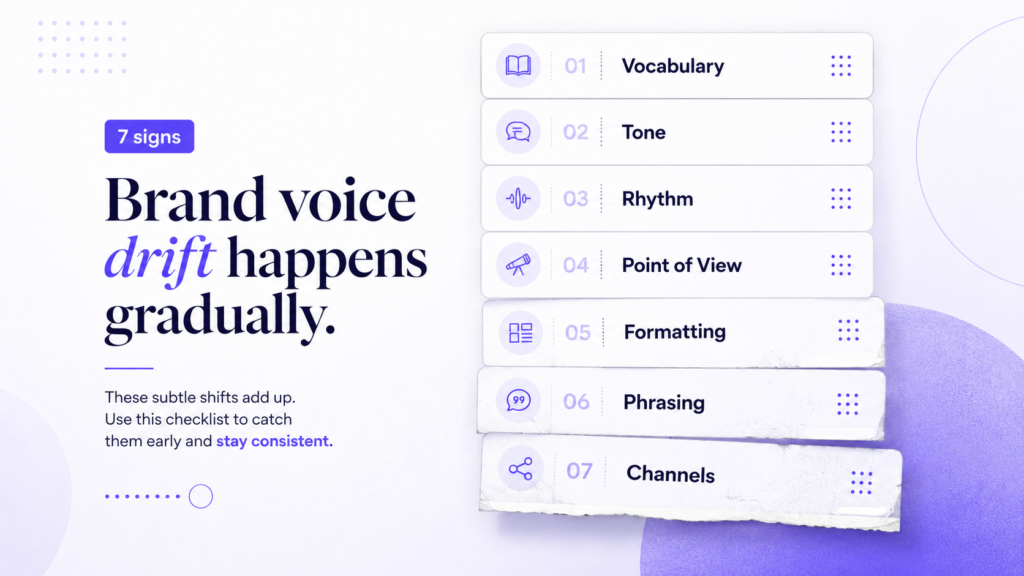
The seven signs a client’s content is drifting off-brand.
Sign 1: The vocabulary starts sliding
The fastest tell is word choice. Every brand has words it prefers and words it bans, and drift shows up when those lines blur. Marlowe & Finch, an invented skincare brand, always says “routine,” never “regimen,” and calls buyers “members,” never “users.” When a new writer files copy full of “regimen” and “users,” the words are fine English but wrong for the brand. Why it matters: vocabulary is the most visible layer of a voice, so slips here are the ones clients notice first. The fix: keep a live preferred-and-banned word list and check every draft against it before it ships.
Sign 2: The tone swings with whoever is writing
When a brand’s formality changes depending on who drafted the piece, the voice has stopped being the brand’s and started being the writer’s. Trailhead Supply, an invented outdoor label, is warm and plain-spoken, but one month its emails read stiff and corporate, the next they are overly casual. Why it matters: readers feel the whiplash even if they cannot name it, and it makes the brand seem unsure of itself. The fix: define the tone range in writing, from its most formal to its most relaxed, and hold every draft inside it.
Sign 3: The sentences lose their rhythm
Rhythm is one of the most recognizable parts of a voice and one of the quietest to lose. Nimbus, an invented software brand, built its voice on short, confident lines. As deadlines pile up, its posts fill with long, hedged, comma-stuffed sentences that could belong to anyone. Why it matters: cadence carries personality, so when the rhythm flattens, the brand blurs into generic copy. The fix: vary sentence length on purpose and read drafts aloud, the places you run out of breath are the places to cut.
Sign 4: The point of view goes generic
A strong brand takes a position. Drift shows up as hedging, qualifiers, and safe filler that could describe any competitor. Veraly, an invented finance app, once said plainly that “budgeting apps overcomplicate a simple job.” Six months on, its blog opens with “in today’s fast-paced world, managing money can be challenging.” Why it matters: a generic point of view is forgettable, and forgettable content does not build a brand. The fix: restate the brand’s actual stance at the top of every piece and cut any line a rival could publish unchanged.
Sign 5: Formatting and naming conventions break
Voice is not only words, it is how things are structured. Oakenford, an invented coffee roaster, writes headlines in sentence case and always styles its product as “cold brew,” two words, lowercase. Drift creeps in as title-case headlines and “ColdBrew” appear at random. Why it matters: inconsistent formatting reads as careless even when the writing is good, and it quietly erodes trust. The fix: put formatting and naming rules in the style guide and treat them as part of the voice, not an afterthought.
Sign 6: Signature phrases get quietly reworded
Most brands have lines that must stay exactly as written, a tagline, a promise, a way of describing what they do. Puffin & Co, an invented toy brand, promises “play that lasts.” When writers paraphrase it into “durable toys for kids,” the meaning survives but the brand does not. Why it matters: signature phrases are earned recognition, and rewording them throws that equity away. The fix: mark protected phrases as verbatim in the guide and flag any draft that changes them.
Sign 7: New channels sound like a different brand
Drift often hides on the newest channel. Sundry, an invented home-goods brand, has a calm, considered blog, but its short-form social posts chase every trend and sound like a different company entirely. Why it matters: audiences move between channels, and a split personality across them breaks recognition and trust. The fix: apply one voice everywhere, adjusting tone for the format without changing the underlying personality, so the brand is unmistakable on every channel.
At-a-glance: the seven signs
| Sign | The off-brand tell | The on-brand fix |
| 1. Vocabulary slips | Preferred words swapped for banned ones | Reset the term list; score drafts against it |
| 2. Tone swings | Formality changes with each writer | Define the tone range and hold every draft to it |
| 3. Rhythm flattens | Sentences all one length, punch gone | Vary length on purpose; read it aloud |
| 4. POV goes generic | Hedging and filler replace a clear stance | Restate the brand’s point of view up front |
| 5. Formatting breaks | Headline case and naming drift | Lock formatting rules in the style guide |
| 6. Signature lines reworded | Taglines paraphrased into blandness | Protect verbatim phrases; flag any change |
| 7. Channels diverge | Social sounds unlike the blog | Apply one voice across every channel |
Drift lowers the consistency score, one unchecked draft at a time.
How to catch content drift before it spreads
The signs above are easy to see once you know them, but no team catches every one by memory across every client. Three habits keep drift contained. First, write the voice down properly, our guide to writing brand voice guidelines your team will use walks through the format, so the rules live somewhere other than one person's head. Second, check drafts against that voice before they publish, not weeks later when the drift is already live. Third, review each channel on a schedule, since the newest channel drifts first.
The common thread is measurement. When brand voice consistency is a subjective judgment, it depends on who reviewed the draft and how much time they had. When it is a number, drift shows up as a lower score you can catch and fix before anything ships.
How Claritar protects brand voice consistency
Making voice measurable is exactly what Claritar does. An agency saves each client's brand voice once, then scores any draft from 0 to 100 against that specific voice. It flags the off-brand lines, the vocabulary slips, the tone swings, the reworded taglines, and returns an on-brand rewrite, so a single unchecked draft cannot quietly move a client off-brand. You can see how the scoring works and check a real piece of content against a saved voice in seconds. Caught early, drift is a quick edit; caught late, it is a quarter of content that no longer sounds like the client.
Frequently asked questions
What causes content to drift off-brand?
Drift is usually structural, not careless. Multiple writers, tight deadlines, new hires, and new channels each introduce small variations that add up. Because no single draft looks wrong, off-brand content accumulates unnoticed until the body of work stops matching the brand's defined voice.
How do you keep brand voice consistency across a team?
Write the voice down clearly, then check every draft against it before publishing rather than relying on memory. Keep a preferred-and-banned word list, define the tone range, protect signature phrases, and review each channel on a schedule so drift is caught while it is still a quick fix.
What is content drift in simple terms?
Content drift is the slow gap between a brand's defined voice and what actually gets published. It creeps in one word or one rushed post at a time, so it is rarely obvious in the moment but clearly visible across a quarter of accumulated content.
How often should you check content for drift?
Check every draft against the saved voice before it publishes, since that is when a fix is cheapest. Beyond that, review each channel on a regular cadence, weekly or monthly, and give extra attention to the newest channel, which tends to drift off-brand first.
Takeaway
Brand voice drift is rarely a single mistake. It is seven small slips, in vocabulary, tone, rhythm, point of view, formatting, signature phrases, and new channels, that add up until a client's content no longer sounds like the client. The agencies that hold brand voice consistency are the ones that spot these signs early and check content against the voice instead of trusting memory.
Want to know exactly where a client's content stands? Score a recent draft against the saved brand voice and see how many of these seven signs are already showing.