

The best tone of voice examples show one thing clearly: a brand’s tone is a choice, not an accident. Whether a brand sounds bold, warm, playful, calm, or expert, the tone is deliberate and consistent, which is exactly what makes it memorable. Below are 25 tone of voice examples across five tone families, each on an invented brand, with what the tone does and what your agency can learn from it.
How to read these tone of voice examples
Tone is how a brand’s fixed personality sounds in a given moment, and it is the layer readers feel first. As you read these brand tone of voice examples, notice three things: the words each brand chooses, its sentence rhythm, and its attitude toward the reader. Those three levers create almost every tone below. If you are still setting the foundation, our guide to what brand voice is covers how voice and tone fit together before you pick a direction.
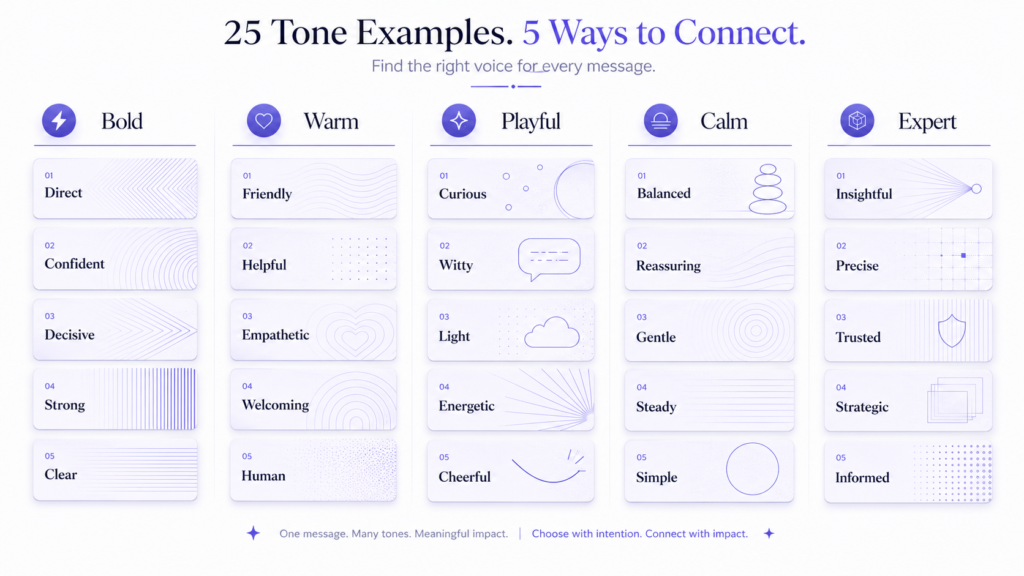
Twenty-five tone of voice examples across five tone families.
Bold and confident tones
These brands sound sure of themselves. Short sentences, strong verbs, and zero hedging.
1. Ironclad Athletics
Blunt and motivating. Ironclad writes in imperatives, “Show up. Do the work.” The lesson: confidence comes from cutting qualifiers, not adding adjectives.
2. Meridian Capital
Assured and precise. It states positions plainly and never overpromises, which reads as expertise. The lesson: certainty and restraint can share the same tone.
3. Volt Energy Bars
High-energy and direct. Punchy fragments and active verbs match the product’s promise. The lesson: tone should echo what the product actually delivers.
4. Basalt Tools
Rugged and no-nonsense. Plain words, zero fluff, built like the products. The lesson: a stripped-back tone signals durability better than describing it.
5. Apex Running
Challenging and aspirational. It talks to the reader as a competitor, not a customer. The lesson: how you position the reader shapes the whole tone.
Warm and friendly tones
Approachable brands that sound like a helpful person, not a corporation.
6. Maple & Main
Homey and reassuring. It writes the way a good neighbor talks, warm without being saccharine. The lesson: warmth works when it stays specific, not gushing.
7. Cariboo Kids
Gentle and encouraging. Soft phrasing and second-person address make parents feel supported. The lesson: match tone to the reader’s emotional state.
8. Harborlight Insurance
Calm and human. It replaces jargon with plain reassurance, rare in its category. The lesson: friendliness is a differentiator in a cold industry.
9. Sunday Roots
Caring and unhurried. Longer, flowing sentences create a relaxed pace. The lesson: rhythm alone can make a tone feel warmer.
10. Pennywhistle Books
Cheerful and inviting. It sounds delighted to share a recommendation. The lesson: genuine enthusiasm reads as friendliness when it is specific.
Playful and witty tones
Brands that use humor and wordplay carefully, to feel human and memorable.
11. Fizzwick Sodas
Cheeky and self-aware. It jokes about its own product without undercutting it. The lesson: humor builds trust when the brand is in on the joke.
12. Nimbus Software
Dry and clever. Understated wit in microcopy makes a technical product feel human. The lesson: small doses of humor go further than constant jokes.
13. Cactus Jack Salsa
Bold and funny. Playful exaggeration matches a fun product. The lesson: let the product’s personality set the ceiling for humor.
14. Doodle Post
Whimsical and light. Friendly puns and a wink keep it charming, not childish. The lesson: playful tone still needs restraint to stay credible.
15. Grumble Coffee
Ironically grouchy. It leans into a mock-grumpy persona that regulars love. The lesson: a consistent comedic angle is stronger than random jokes.
Calm and minimal tones
Quiet, considered brands that say less and mean more.
16. Linen & Stone
Spare and elegant. Few words, lots of space, every sentence earns its place. The lesson: what you leave out defines a minimal tone.
17. Still Water Skincare
Serene and understated. Soft, simple statements mirror the product’s promise. The lesson: calm tone is built from short, plain sentences.
18. Northwind Studio
Precise and quiet. Confident minimalism with no filler. The lesson: minimal is not empty; every word is deliberate.
19. Slate & Ash
Refined and measured. It trusts the reader to fill in the rest. The lesson: restraint signals confidence.
20. Meadowlark Tea
Soothing and simple. Gentle pacing and plain language create ease. The lesson: tone can lower the reader’s pulse on purpose.
Authoritative and expert tones
Brands that lead with knowledge and earn trust through clarity.
21. Vantage Analytics
Clear and credible. It explains complex ideas simply, which reads as mastery. The lesson: real authority simplifies, it does not obscure.
22. Kepler Medical
Precise and trustworthy. Careful, exact language builds confidence in a high-stakes field. The lesson: precision is a tone, and it earns trust.
23. Foundry Consulting
Direct and seasoned. It speaks from experience without arrogance. The lesson: authority and humility can coexist in one tone.
24. Beacon Academy
Guiding and patient. It teaches rather than lectures. The lesson: an expert tone can still be generous and warm.
25. Terrace Financial
Steady and reassuring. Measured phrasing signals reliability. The lesson: consistency of tone is itself a trust signal.
The five tone families at a glance
| Tone family | What it sounds like | Best for |
| Bold and confident | Short sentences, strong verbs, no hedging | Brands selling performance or expertise |
| Warm and friendly | Plain, human, second-person, reassuring | Consumer brands in cold categories |
| Playful and witty | Humor and wordplay used with restraint | Brands with a fun, low-stakes product |
| Calm and minimal | Spare, simple, deliberate, lots of space | Premium, design-led, or wellness brands |
| Authoritative and expert | Clear, precise, credible, simplifying | High-trust or complex categories |
Five tone families and where each one fits best.
How to build your own tone of voice
Turning these examples into your own tone takes four moves. First, pick the one or two families that fit the brand’s personality and audience, not the ones that sound impressive. Second, choose your levers deliberately: word choice, sentence rhythm, and attitude toward the reader. Third, write a short set of tone of voice guidelines with before-and-after examples so writers can copy the pattern. Fourth, test it on real content: an email, a landing page, a social post, and adjust until it sounds unmistakably like the brand across all three.
If you want the full framework, our guide to writing brand voice guidelines your team will use walks through documenting tone so a whole team can apply it, not just the person who defined it.
Keeping your tone consistent
A tone is only as good as its consistency. The moment it shifts with whoever is writing, it stops being the brand’s tone, and those are the first signs a client’s content has drifted off-brand. Claritar keeps tone steady by saving each client’s voice once and scoring every draft against it from 0 to 100, flagging the lines that slip and returning an on-brand rewrite. You can see how the scoring works and check any draft against a saved tone in seconds, so the examples you admire become a standard you actually hold.
Frequently asked questions
What is a tone of voice example?
A tone of voice example shows how a specific brand sounds in its writing, the words, rhythm, and attitude that make it recognizable. Comparing several examples reveals that tone is a deliberate choice: bold, warm, playful, calm, or expert, chosen to fit the brand and its audience.
How many tones of voice are there?
There is no fixed number, but most brand tones cluster into a handful of families, such as bold, warm, playful, calm, and authoritative. Many brands blend two, for example warm and witty, and then flex within that range depending on the situation.
What is the difference between voice and tone?
Voice is a brand’s fixed personality; tone is how that personality flexes by context. A warm brand stays warm everywhere but shifts tone between a celebration and an apology. The tone of voice examples above show the personality; tone is the moment-to-moment adjustment.
How do you choose a tone of voice for a brand?
Start from the brand’s personality and audience, not from tones you find impressive. Pick one or two tone families that fit, define your levers of word choice, rhythm, and attitude, then test the tone on real content until it sounds consistent across every channel.
Takeaway
The 25 tone of voice examples above share one trait: each brand made a deliberate choice and held it consistently. That consistency, more than any single clever line, is what makes a tone memorable and a brand recognizable. Pick the family that fits, define your levers, and apply the tone the same way on every channel.
Want to keep your chosen tone consistent across every draft and client? Score your content against a saved brand voice and see where the tone holds and where it slips.