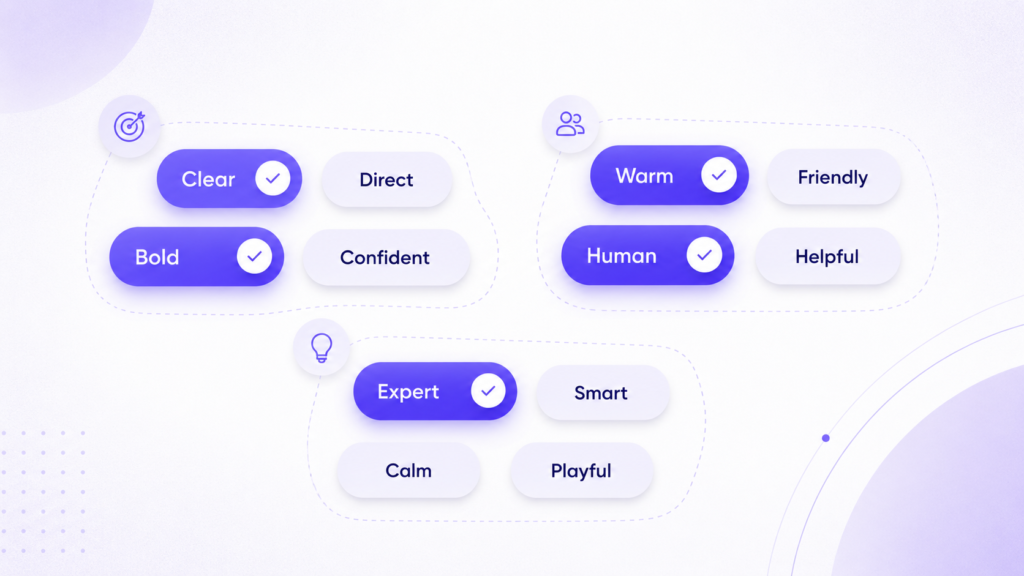

The brand voice vs tone question trips up even experienced marketers, and getting it wrong leads to inconsistent content. The short answer: voice is your brand’s fixed personality, and tone is how that personality flexes to fit the moment. This guide makes the difference between voice and tone clear, with examples, so your team can hold one voice while adjusting tone the right way.
What brand voice is
Brand voice is the consistent personality a brand expresses in its writing, its traits, word choices, and point of view. It does not change from one piece to the next. A warm, witty brand is warm and witty in a product page, an email, and a support reply. If you want the full picture, our guide to what brand voice is covers it in depth, and our 25 tone of voice examples show tone in action. The key idea is simple: voice is fixed.
What tone is
Tone is how that fixed voice adapts to a specific situation and audience. The same brand shifts tone between a celebration and an apology, between a sales page and a help article, without changing who it is. Tone is the emotional coloring of a single message; voice is the personality underneath every message. Voice is the person; tone is their mood in the moment.
Brand voice vs tone: the core difference
The cleanest way to hold the difference between voice and tone in mind is that voice stays the same everywhere while tone moves with context. Here is the contrast at a glance.
| Brand voice | Tone | |
| Changes? | Stays constant | Shifts with context |
| What it is | The brand’s personality | The mood of one message |
| Decided | Once, then documented | Per piece, within the voice |
| Example | Warm, witty, direct | Gentle in an apology, upbeat at launch |
| Scope | Everything the brand writes | A single piece of content |
Brand voice vs tone at a glance.
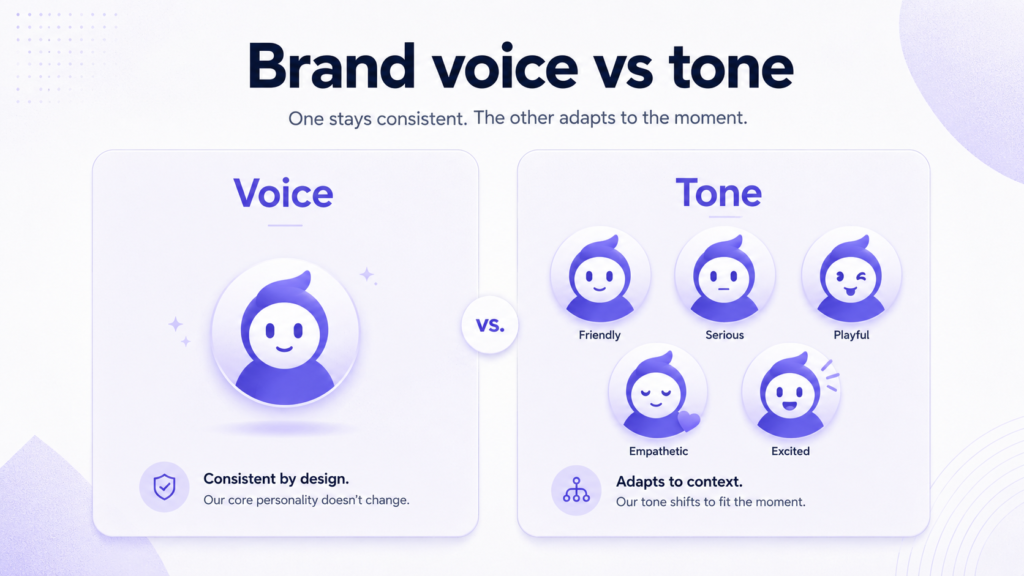
Brand voice stays fixed while tone shifts with context.
Voice and tone in action (examples)
Take an invented brand, Harborlight Insurance, whose voice is calm, human, and plain-spoken. That voice never changes, but its tone flexes by situation:
- Launch announcement: the tone is warm and quietly excited, “New cover that actually makes sense, starting today.”
- Service outage apology: the tone is accountable and reassuring, “We got this wrong, and here’s exactly how we’re fixing it.”
- Help article: the tone is patient and practical, “Here’s how to update your policy in three steps.”
- Renewal reminder: the tone is low-key and helpful, “Your cover renews next month, nothing you need to do.”
In every message, Harborlight sounds like Harborlight, calm, human, plain. Only the tone moves. That is brand voice and tone working together correctly: one personality, many appropriate moods.
How to apply voice and tone consistently
Applying both well comes down to three moves. First, define the voice once and write it down, our guide to brand voice guidelines shows how. Second, map your tone range across a few common situations so writers know how far they can flex without leaving the voice. Third, check drafts against the voice, since tone drift is subtle and easy to miss. When tone stops serving the voice and starts replacing it, that is one of the early signs a client’s content has drifted off-brand.
How Claritar helps
Keeping one voice steady while tone flexes is hard to police by eye across many writers and clients. Claritar makes it measurable: it saves each client’s voice once, then scores any draft from 0 to 100 against it, flagging lines where the tone has drifted off the underlying voice and returning an on-brand rewrite. You can see how the scoring works and confirm that a draft flexes tone without losing the voice, on every piece of content.
Frequently asked questions
What is the difference between brand voice and tone?
Brand voice is a brand’s fixed personality, consistent across everything it writes. Tone is how that personality flexes to fit a specific situation or audience. Voice stays the same; tone shifts. A brand keeps one voice but uses many tones within it.
Can a brand have more than one tone?
Yes. A brand should have one voice but many tones, one for launches, another for apologies, another for support. What matters is that every tone still sounds like the same underlying voice, so the brand stays recognizable across situations.
Which comes first, voice or tone?
Voice comes first. You define the brand’s fixed personality, then decide how its tone flexes within that personality by context. Setting tone before voice leads to inconsistent content, because there is no stable personality holding the tones together.
Why does the voice vs tone distinction matter?
Because confusing the two produces inconsistent content. Teams that treat tone as voice let the brand’s personality change with each situation, which breaks recognition. Understanding that voice is fixed and tone flexes keeps content varied but unmistakably on-brand.
Takeaway
Brand voice vs tone comes down to one idea: voice is the fixed personality, tone is how it flexes for the moment. Keep one voice everywhere, adjust tone by context, and never let tone quietly replace the voice. Get that balance right, and your content stays both varied and unmistakably on-brand.
Want to be sure your tone flexes without losing the voice? Score a draft against your saved brand voice and see exactly where it holds.