

What is brand voice? It’s the consistent personality and style a brand uses in everything it writes, from website headlines to support emails to social captions. It’s what makes copy sound unmistakably like one company instead of anyone. For an agency writing on behalf of a dozen clients at once, holding that voice steady is exactly where consistency starts to slip, and this guide shows why, and what to do about it.
What brand voice is
So what is brand voice, in practice? The clearest brand voice definition is this: brand voice is the personality of a brand expressed through words. Every choice, sentence length, formality, humor, the words you use and the ones you refuse to, adds up to a voice a reader recognizes.
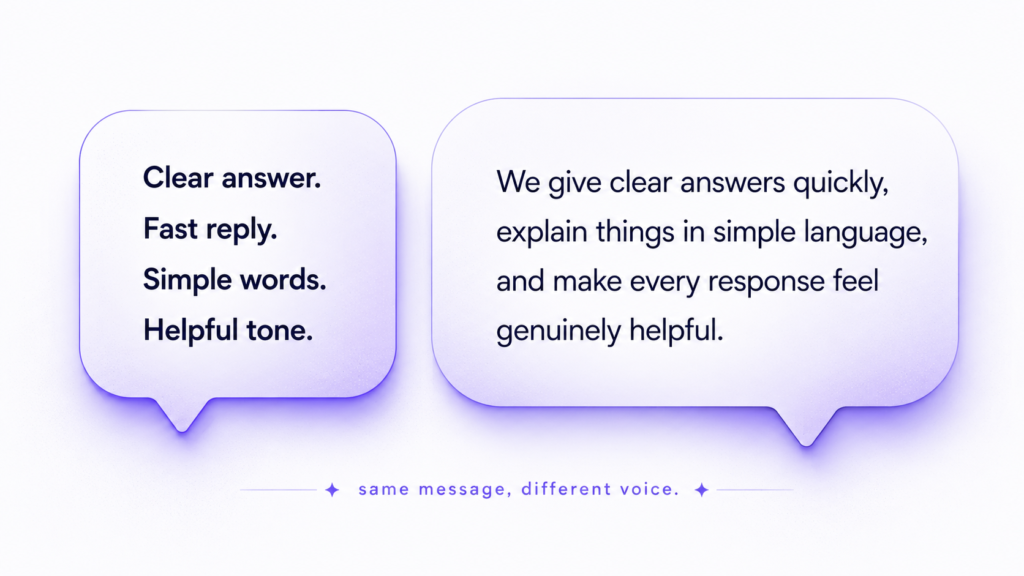
What is brand voice
A good way to understand the brand voice meaning is by contrast. Picture two invented outdoor brands. Summitline writes in short, plain, confident lines: “Built for the climb. Nothing you don’t need.” Wanderknit leans warm and playful: “Grab your coziest layer, friend, adventure’s calling, and it’s a little chilly out there.” Same industry, completely different voices. Neither is wrong. What matters is that each one sounds like itself every single time.
Voice is a strategic asset, not a stylistic accident. It’s decided once, documented, and then applied consistently across every piece of content a brand publishes.
Why brand voice matters at scale
Once you know what brand voice is, its value is clear. A consistent voice builds recognition: the more reliably a brand sounds like itself, the faster audiences learn to identify and trust it, the same way you recognize a friend’s texting style before you see their name.
It also signals credibility. Copy that wanders between formal and casual, or swaps terminology mid-page, reads as disorganized even when the underlying work is excellent. Consistency looks like competence, and inconsistency quietly undermines it.
For agencies, the stakes are higher because the risk multiplies. An agency running ten clients, each publishing across a blog, email, and three social channels, is holding dozens of distinct voices every week. A freelancer covering for a sick teammate has never internalized that client’s rules. A new hire hasn’t absorbed them yet. A rushed Friday post skips the guidelines entirely. None of these are failures of talent. They’re the natural result of scale, memory, and human variation, and they’re why brand voice is the thing agencies lose first.
The usual defenses don’t hold up. A brand voice guide that lives in a shared drive gets read once and forgotten. Manual review depends on one senior editor remembering every client’s rules and having time to check every draft, which never lasts. And general-purpose writing tools flag grammar and clarity, not whether a sentence sounds like this specific client. A sentence can be flawless English and still be completely off-brand. So drift creeps in quietly, and the client often notices before the agency does, usually after several visible signs the content has drifted off-brand have already piled up.
Brand voice vs. tone, and the four parts of a voice
People use “voice” and “tone” interchangeably, but they describe different things. Voice is fixed. Tone shifts with context.
Voice vs. tone
A brand keeps one voice but flexes its tone. A warm, witty brand is still warm and witty when handling a refund; it just dials the humor down and the empathy up. The voice sets the boundaries; the tone moves around inside them. Research groups like the Nielsen Norman Group map tone across dimensions such as formal-to-casual and serious-to-funny, useful shorthand for describing how a voice flexes.
| Brand voice | Tone |
| Stays the same everywhere | Adjusts to the situation |
| The brand’s core personality | The mood of one specific message |
| Decided once, documented | Chosen per piece, within the voice |
The four parts of a brand voice
Most brand voices break down into four working parts. Personality is the human traits behind the words, confident, friendly, authoritative. Vocabulary is the words a brand reaches for and the ones it bans, one brand says “customers,” another insists on “members.” Sentence structure and rhythm is whether it’s short and punchy or flowing and detailed, one of the most recognizable parts of a voice and the easiest to lose. Values and point of view is what the brand believes and how directly it says so. Document these four, and an abstract “feel” becomes something a whole team can apply.
A consistency meter climbing from off-brand toward on-brand.
How to find your brand voice
If you’re working out how to find your brand voice from scratch, a few concrete moves get you most of the way there.
Start by studying what already resonates. Pull the content that has performed best or felt most “you,” and look for the patterns in word choice and rhythm. Then describe the brand as a person: if it walked into a room, how would it talk? Pick three or four personality adjectives and pressure-test them, “friendly” is weak until you decide friendly-like-a-mentor versus friendly-like-a-neighbor.
From there, set concrete rules. List preferred and banned words, note the ideal sentence length, and capture do’s and don’ts with real before-and-after examples. Examples teach a voice faster than adjectives ever will. Finally, write it into a short, usable guide so the whole team, not just its author, can apply it. If you want a head start, our guide to writing brand voice guidelines your team will use walks through the format.
How Claritar helps
Defining a voice is one thing. Holding it steady across every writer, client, and deadline is the harder part, and it’s where memory and manual review fall short. The fix is to make brand voice measurable instead of a matter of opinion, so any draft can be checked before it ships rather than corrected weeks later.
That’s what Claritar does. An agency saves each client’s brand voice once, then scores any draft from 0 to 100 against that specific voice. It flags the lines that drift off-brand and returns an on-brand rewrite, so consistency stops depending on who wrote the piece or how close the deadline was. You can see how the scoring works and try it on a real draft. Voice defined once, applied the same way every time, is how agencies keep each client sounding like itself, at scale.
Frequently asked questions
What is brand voice in simple terms?
Brand voice is the consistent personality a brand uses in its writing. It’s the mix of traits, words, and style that makes a company’s content recognizably its own across every channel, so a reader could cover the logo and still know exactly who is speaking.
What is the difference between brand voice and tone?
Voice is the brand’s fixed personality and stays the same everywhere. Tone is how that personality flexes for a situation, gentler in an apology, more upbeat in a launch. You keep one voice and adjust the tone within it, never the other way around.
How do you find your brand voice?
Study your best-performing content for patterns, describe the brand as a person, and choose three or four personality adjectives. Then set concrete preferred and banned word rules with real before-and-after examples, and write it all into a short brand voice guide the whole team can apply.
Why do agencies struggle to keep brand voice consistent?
Because they manage many voices across many writers and deadlines. Shared documents get forgotten, manual review does not scale, and general writing tools check grammar rather than whether copy matches a specific client’s voice. Drift sets in gradually, and clients often notice before the agency does.
Can brand voice be measured?
Yes. By saving a client’s voice and scoring each draft against it, consistency becomes a number you can check before publishing instead of a subjective call made afterward. A clear score also flags the exact lines that drift off-brand, so they are fixed before anything ships.
Takeaway
So what is brand voice, in one line? It is the consistent personality a brand expresses in words, distinct from tone, and built from personality, vocabulary, rhythm, and point of view. It’s one of the most durable assets a brand can own, and one of the first things an agency loses at scale.
The agencies that keep every client on-brand are the ones who stop relying on memory and make voice measurable. Score your next draft against a saved client voice and see how close it lands.