

A content style guide is the rulebook that keeps everything a team writes consistent, from voice and tone to grammar, formatting, and word choice. Without one, every writer makes their own small decisions and the brand ends up sounding like a committee. This guide shows how to build a content style guide, with a copy-ready template and an example you can follow.
Why you need a content style guide
A content style guide removes a thousand tiny arguments. Is it “e-commerce” or “ecommerce”? Do we use the Oxford comma? Should headlines be title case? Answered once, these decisions stop eating time and stop making content look inconsistent. An editorial style guide is what lets a team of writers sound like a single, deliberate brand.
It pairs closely with brand voice. Where brand voice guidelines define how the brand sounds, a content style guide covers the mechanics that keep that sound consistent on the page. Together they close most of the gaps where the signs of off-brand content creep in.
The content style guide template
Here is a simple, copy-ready content style guide template. Fill each section once, keep it scannable, and store it where writers actually work.
CONTENT STYLE GUIDE

1. Purpose & audience: [who this guide is for + who you write for]
2. Voice & tone: [3-4 personality traits + how tone shifts by context]
3. Grammar & mechanics: [Oxford comma? contractions? sentence length]
4. Formatting: [headline case, capitalization, numbers, dates, lists]
5. Word choice: [preferred words, banned words, how you name things]
6. Punctuation: [em-dash rules, ampersands, exclamation points]
7. Links & CTAs: [anchor style, CTA phrasing]
8. Accessibility: [alt text, plain language, reading level]
9. Examples: [before/after pairs for the rules that matter most]
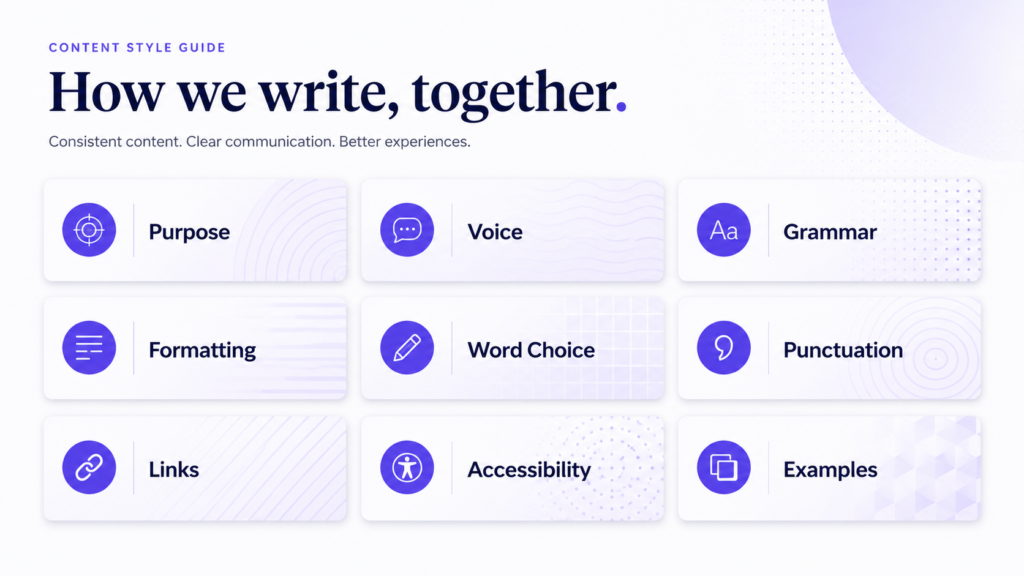
The core sections of a content style guide.
How to fill it in (with an example)
Walk through the template with an invented brand, Fern & Field, a sustainable homeware company, to see how each section turns from a prompt into a rule.
Purpose and audience
Fern & Field writes for design-conscious homeowners who care about where things come from. The guide exists so freelancers and staff sound identical. Naming the audience up front keeps every later rule grounded in who is reading.
Voice and tone
Three traits: warm, considered, and honest. Tone stays calm in most content and turns practical in how-to pieces. This section links out to the fuller brand voice guide rather than repeating it.
Grammar and mechanics
Contractions are welcome, sentences stay short, and the Oxford comma is standard. These small, fixed choices are what make separate writers read as one voice.
Formatting and word choice
Headlines use sentence case, numbers under ten are spelled out, and the brand always writes “homeware,” one word. It prefers “materials” over “stuff” and bans “eco-friendly” as too vague. Clear word rules prevent the most visible drift.
Examples
For the rules that matter most, Fern & Field pairs an off-brand sentence with its on-brand rewrite. A single before-and-after teaches a rule faster than a paragraph explaining it, which is why this section does the heaviest lifting.
How to keep your style guide enforced
A style guide only works if drafts are actually checked against it, and no team catches every rule by memory across every client. Claritar makes the check automatic: it saves each client’s voice and rules once, scores any draft from 0 to 100 against them, flags the banned words and off-brand lines, and returns an on-brand rewrite. Instead of hoping writers remember the guide, you get an objective check on every piece. You can see how the scoring works and keep your content style guide live rather than forgotten in a shared folder.
Frequently asked questions
What is a content style guide?
A content style guide is a document that defines the rules for how a team writes: voice and tone, grammar, formatting, word choice, and punctuation. It keeps content consistent across writers and channels, so a brand reads as one deliberate voice rather than many.
What is the difference between a style guide and a brand voice guide?
A brand voice guide defines personality and tone, how the brand sounds. A content style guide covers mechanics like grammar, formatting, and capitalization. They overlap and often live together, with voice governing character and style governing consistency of presentation.
What should a content style guide include?
Include purpose and audience, voice and tone, grammar and mechanics, formatting, word choice, punctuation, link and CTA style, accessibility, and before-and-after examples. Keep each section short and scannable so writers actually use it rather than skim it once.
Do small teams need a content style guide?
Yes. Even a two-person team makes dozens of small style decisions, and a short guide keeps those consistent as the team and content grow. A one-page version covering voice, key word choices, and formatting is enough to start.
Takeaway
A content style guide settles the small decisions once, so a whole team writes as one voice. Build it from the template above, fill each section with clear rules and real examples, and keep it short. The guide only earns its place if drafts are checked against it, so make enforcement part of the process, not an afterthought.
Want your style rules checked on every draft? Score your content against a saved brand voice and keep the whole team consistent.