

A brand messaging framework is the single document that defines what a brand says, to whom, and why it matters, so every writer stays on message. Without one, messaging drifts from person to person and channel to channel. This guide gives you a step-by-step brand messaging framework, a copy-ready template, and examples, so your messaging strategy stays consistent everywhere.
What a brand messaging framework is and why it matters
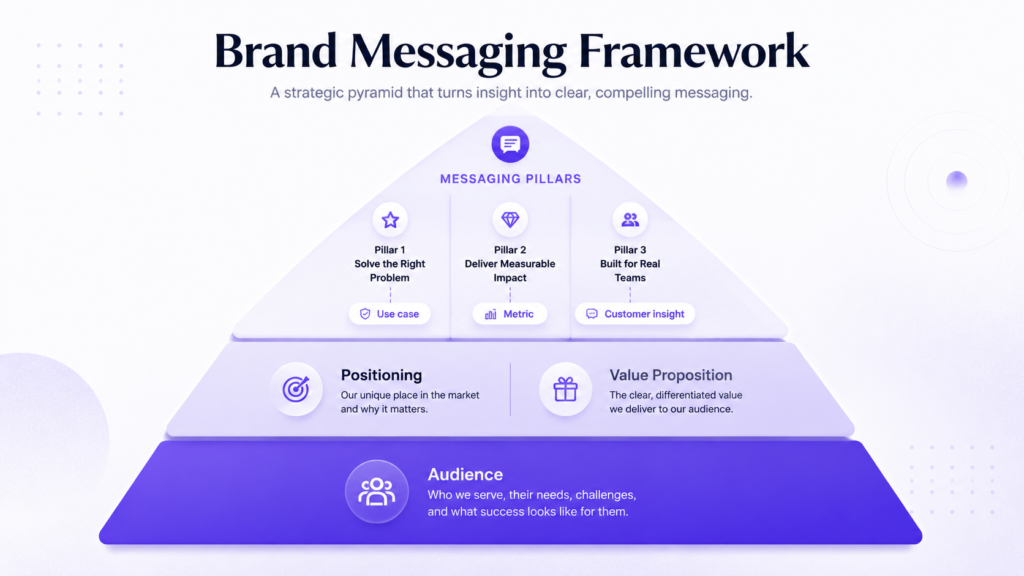
A brand messaging framework is a structured set of core messages, the audience and their problem, a positioning statement, a value proposition, a few messaging pillars with proof, and the voice that ties them together. It is the reference every piece of content points back to, so the brand makes the same promises consistently.
A clear brand messaging strategy matters most at scale. When many writers work across many channels, an undocumented message fragments quickly, and the gap between what the brand means to say and what actually ships is where the early signs of off-brand content appear. A framework turns messaging from tribal knowledge into a shared standard.
The brand messaging framework template
Here is a simple, copy-ready template. Fill each field once per brand, keep it to a single page, and point every writer to it.
BRAND MESSAGING FRAMEWORK

Audience: [who you serve + their main problem]
Positioning statement: For [audience] who [need], [brand] is the [category] that [key benefit], unlike [alternative].
Value proposition: [one sentence on the core promise]
Messaging pillar 1: [theme] - supporting message + proof point
Messaging pillar 2: [theme] - supporting message + proof point
Messaging pillar 3: [theme] - supporting message + proof point
Boilerplate: [2-3 sentence standard description]
Voice: [3-4 personality traits + tone notes]
A one-page brand messaging framework template.
How to build your messaging framework in 6 steps
The six steps below fill the template in order, each building on the last.
From audience to proof: the messaging framework build order.
The six steps to build a brand messaging framework.
Step 1: Define your audience and their problem
Name exactly who the brand serves and the core problem it solves for them. Why it matters: every message that follows is only as sharp as this definition. Example: an invented brand, Cargose, serves small e-commerce shops drowning in shipping admin, a problem specific enough to guide every later message.
Step 2: Write your positioning statement
Use the classic form: for [audience] who [need], [brand] is the [category] that [benefit], unlike [alternative]. Why it matters: positioning is the spine the whole framework hangs on. Example: Cargose positions itself as the shipping tool that removes admin for small shops, unlike general logistics platforms built for enterprises.
Step 3: Craft the core value proposition
Distil the positioning into one plain-language promise a customer would repeat. Why it matters: if the value proposition is not memorable, no campaign will fix it. Example: Cargose lands on “shipping that runs itself,” a single line that captures the benefit.
Step 4: Build three or four messaging pillars
Break the value proposition into a few supporting themes, the recurring points every campaign returns to. Why it matters: pillars keep messaging varied but consistent. Example: Cargose uses three pillars, save time, avoid errors, and look professional, each a theme its content circles back to.
Step 5: Add proof points to each pillar
Back every pillar with evidence, a stat, a feature, a customer outcome. Why it matters: claims without proof are just adjectives. Example: under “save time,” Cargose cites the hours of weekly admin its tool removes, turning a promise into a proof point.
Step 6: Lock the voice and boilerplate
Finish with the brand’s voice traits and a standard boilerplate so the framework governs how messages sound, not just what they say. Why it matters: consistent messaging needs a consistent voice. Example: Cargose records a practical, plain-spoken voice and a three-sentence boilerplate every writer reuses verbatim.
Common mistakes to avoid
Watch for the mistakes that quietly weaken a messaging framework:
- Skipping the audience definition. Vague messaging almost always traces back to a fuzzy sense of who it is for.
- Positioning by feature, not benefit. Customers buy the outcome, so lead with the benefit and support it with features.
- Too many pillars. More than four themes and no one, including your team, remembers them.
- Claims without proof. Every pillar needs evidence, or it reads as generic marketing.
- Documenting what to say but not how to say it. Without a defined voice, the same message sounds different in every writer’s hands.
How Claritar keeps your messaging on-brand
A messaging framework defines the message; the challenge is holding every draft to it. Claritar saves each client’s voice and messaging rules once, then scores any draft from 0 to 100 against them, flagging off-message or off-brand lines and returning an on-brand rewrite. Combined with clear brand voice guidelines, it turns your framework from a reference document into an active check on every piece of content. It also slots into your content approval workflow, giving each draft a message check before publish. You can see how the scoring works and hold your messaging to one standard across every writer and channel.
Frequently asked questions
What is a brand messaging framework?
A brand messaging framework is a structured document that defines a brand’s audience, positioning, value proposition, messaging pillars, proof points, and voice. It gives every writer one reference so the brand makes the same promises consistently across channels and campaigns.
What is the difference between messaging framework and brand strategy?
A brand strategy is the broad plan for how a brand competes and grows. A brand messaging framework is the narrower, practical layer that defines what the brand actually says. The framework operationalizes the strategy into repeatable, on-message content.
What are messaging pillars?
Messaging pillars are the three or four core themes a brand’s communication returns to, each supporting the value proposition and backed by proof. They keep messaging varied enough to stay interesting but consistent enough to be recognizable.
How long should a brand messaging framework be?
Keep it to a single page where possible. A framework is only useful if writers actually reference it, so a concise, scannable one-pager beats a long document. Detail and examples can live in a supporting appendix for those who need them.
Takeaway
A brand messaging framework aligns audience, positioning, value proposition, pillars, proof, and voice into one reference, so a whole team says the same thing consistently. Build it once with the template above, keep it to a page, and hold every draft to it. A framework only works when it shapes the content, not just the strategy deck.
Want your messaging held to one standard on every draft? Score your content against a saved brand voice and keep every writer on message.